

P0DECal software
(Susan Cartwright, Ben Still)
One of the primary physics goals of the T2K ND280 is the measurement of π0 production, especially in the neutral current single π0 (NC1π0) channel νμX →νμX' π0. This channel is a potential source of background for νe appearance measurements in Super-K, since asymmetrically decaying π0s can yield a single energetic electromagnetic shower whose Cerenkov signature is essentially identical to that of an electron.
The Pi-Zero Detector or P0D is the ND280 subdetector charged with this task. However, low-energy photons can travel large distances before pair-producing, so one or both photons from a π0 decay can easily be entirely or partially lost from the P0D, as in the simulated event displayed here. To reduce the effect of this, the P0D is surrounded on all sides by tagging calorimeters designed to contain and identify escaping photons. The upstream and downstream calorimeters are part of the main P0D, but the side calorimeters (the P0DECal) are part of the ECal and are a UK responsibility. (In the event shown, the shower lost from the P0D is seen in the P0DECal.) The Sheffield group has been responsible for all aspects of P0DECal software, from design optimisation to particle identification, and is currently studying the impact of including the P0DEcal information on the efficiency of NC1π0 selection.
Design optimisation and hit clustering
While the ECal around the ND280 tracker is required to measure the energy of photon showers, the primary purpose of the P0DECal is simply identification and containment. Budget constraints led to a much descoped version of the full ECal, with only 6 scintillator layers. The main remaining design variable was the thickness of the interleaved lead foil. Truth-level simulation studies carried out by the Sheffield T2K group were used to optimise this in terms of photon shower containment and photon/muon discrimination. A lead thickness of 4 mm was selected based on these studies. Later, more sophisticated, analyses have demonstrated that good photon-muon separation is indeed possible despite the minimal nature of the detector.
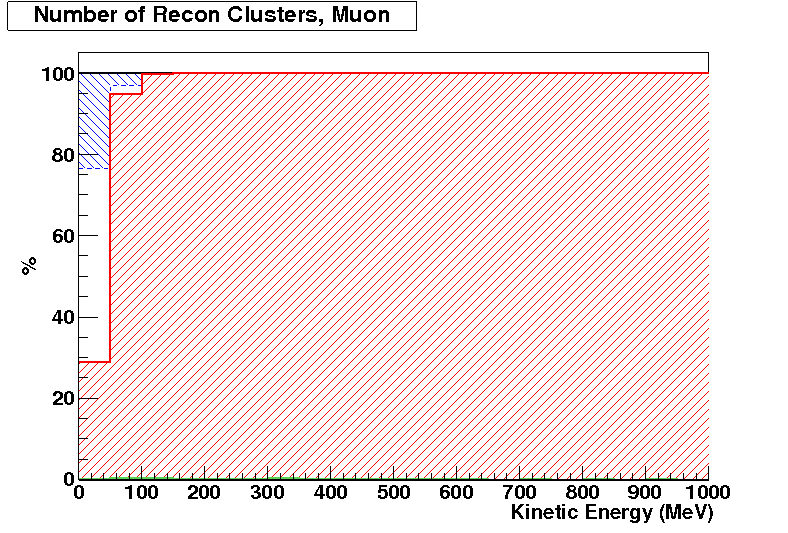
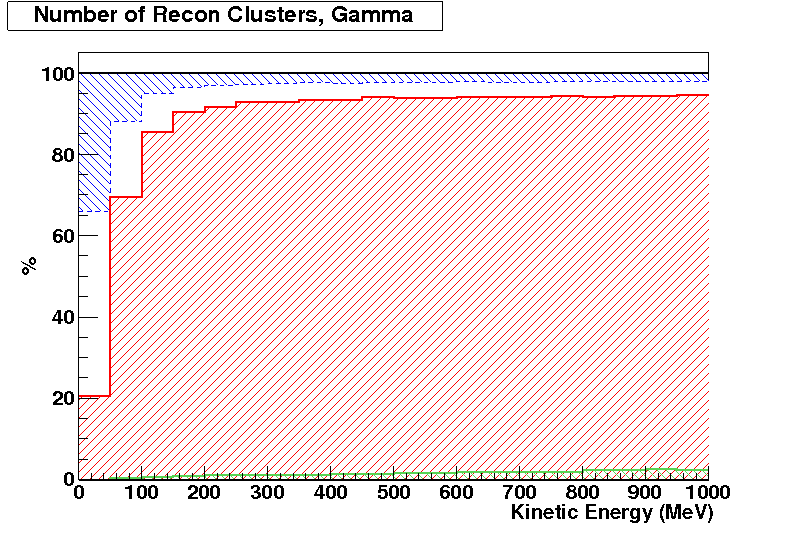
Clustering of hits is performed using a simple nearest-neighbour aggregation method. More sophisticated algorithms such as Hough transforms (as used in the P0D proper) were investigated but were not found to improve the performance of the algorithm. The figures below show the performance of the clustering as a function of the energy of the incident particle; it can be seen that the performance is poor only at low particle energies, where the number of bars hit is very small.
|
|
|
Clustering success for muons (left) and photons (right). Blue indicates an unreconstructable particle
which left only one usable hit; red indicates successful reconstruction into a single cluster; green
indicates reconstruction of two clusters (fragmentation). The gap between red and blue represents
failure of the clustering (a potentially reconstructable cluster is not found).
|
|
Particle identification using multivariate analysis
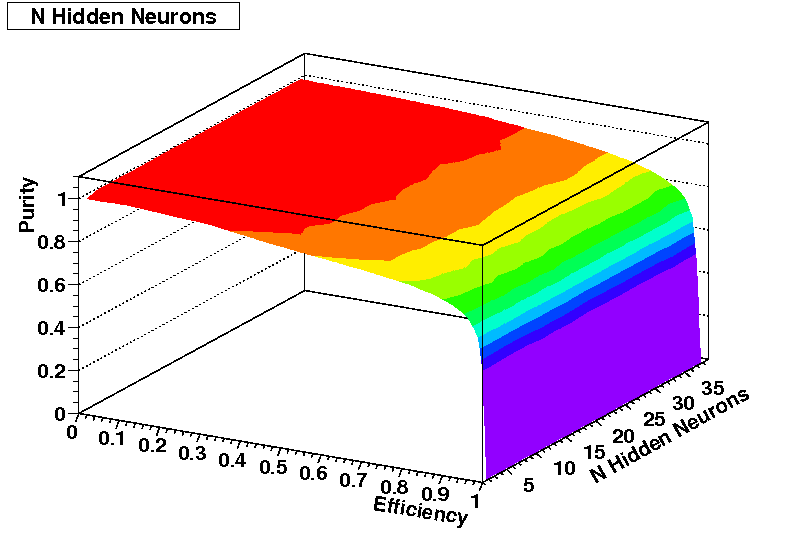
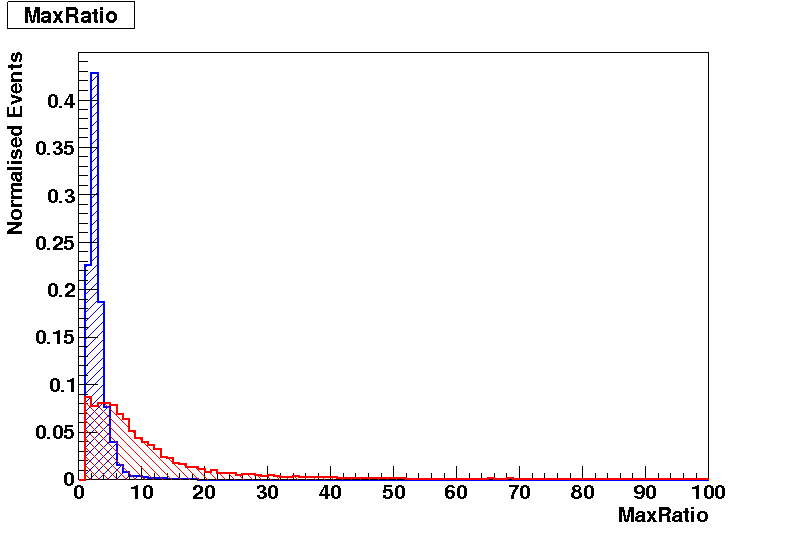
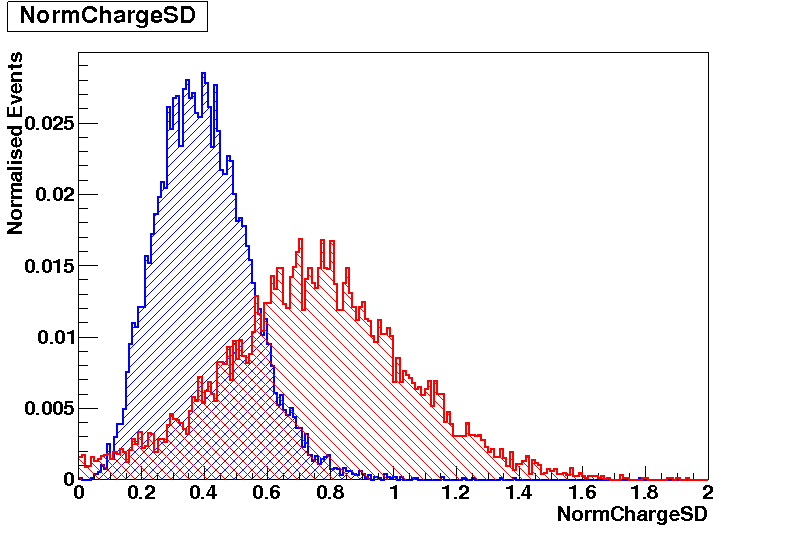
In order to maximise the efficiency of particle identification given the limited amount of information available, non-linear multivariate techniques were employed. Both boosted decision trees and neural networks (multilayer perceptrons) were considered, the latter being selected on the basis of lower computation time and wider usage within the particle physics community. A set of discriminating variables were chosen on the basis of track-shower discrimination and minimal correlation with energy (energy is a confounding variable since the P0DECal does not reconstruct the energy of showers with any precision, owing to the low sampling rate). The figures below show two examples of discriminating variable distributions.
|
|
Typically, the neural network achieved success rates of around 86% (defined as the fraction of events correctly classified in a test sample with equal numbers of tracks and showers).
Effects on π0 reconstruction efficiency
The effects of incorporating the P0DECal into the standard P0D-based π0 reconstruction analysis are currently under study by the Sheffield T2K group. The present preliminary results do not use any energy information from the P0DECal, nor do they attempt to match partially contained P0D clusters to P0DECal clusters. However, preliminary indications are that it should be possible to increase the P0D fiducial volume, and therefore the statistics obtained, by as much as 2/3 with only a minor reduction in the purity of the selected sample. This performance is expected to improve if we can develop a method of reconstructing the energy of P0D showers using a similar multivariate technique to that employed in the particle identification analysis.